1 gorilla vs 100 humans: who actually wins?
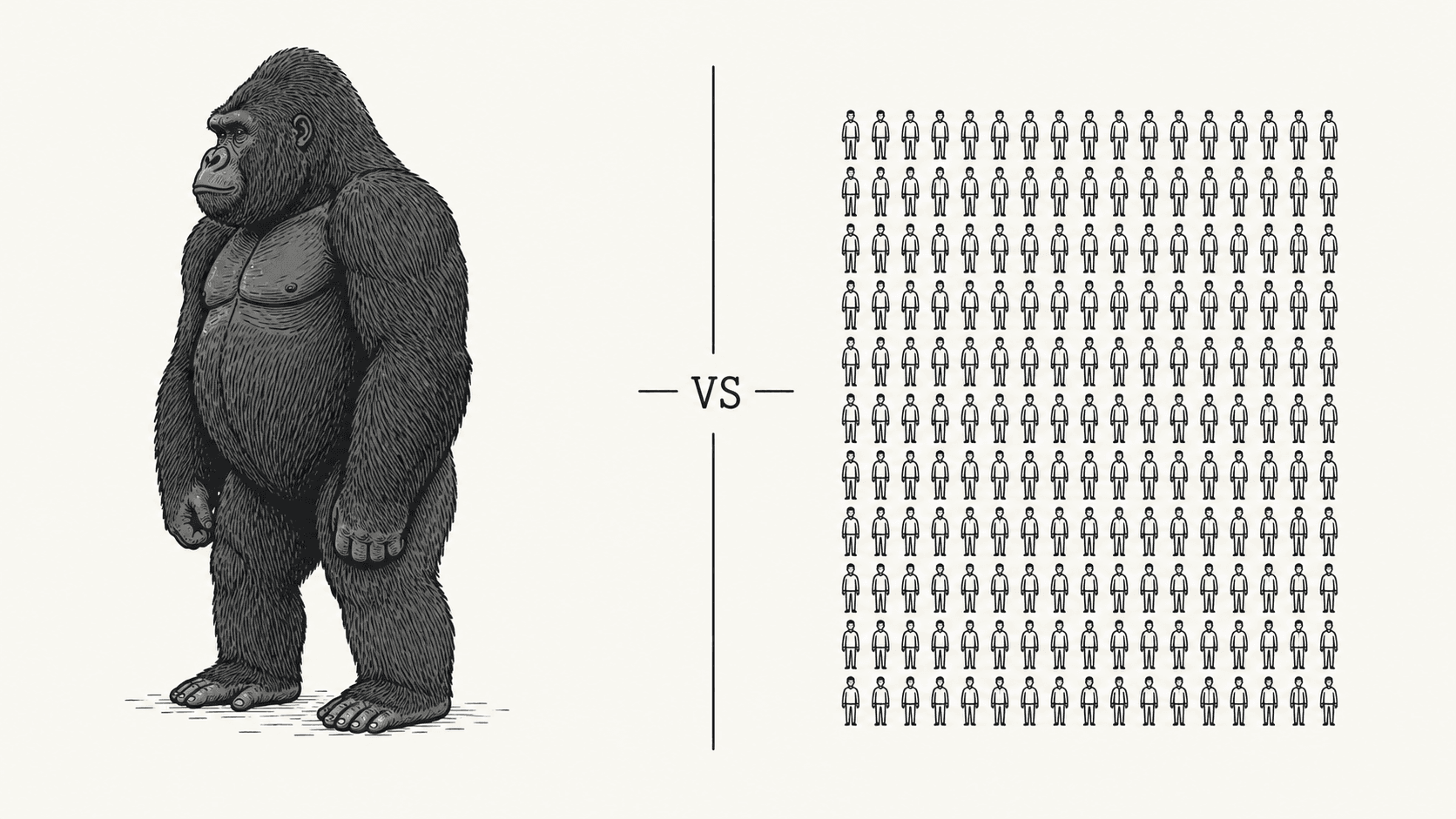
This question has been asked approximately four thousand times on the internet, usually with an angry gorilla GIF attached. We're going to answer it properly.
Ground rules
Before we calculate anything, let's nail down what we mean. One adult male Western gorilla (Gorilla gorilla gorilla): around 170 kg, healthy, fully grown. One hundred adult humans: typical population mix (50% men, 50% women), no special training, no weapons, no equipment. Neutral arena: enclosed, flat ground, no escape routes (because otherwise the answer is just “the humans run away and the gorilla wins by forfeit”).
We'll look at four different scenarios: free-for-all, organized fight, endurance, and collective intelligence. The outcome depends almost entirely on which one we're talking about.
Scenario 1 — Free-for-all (everyone charges at once)
The numbers first.
An adult Western gorilla generates an estimated bite force of around 1,300 PSI (~9 MPa), roughly 8× that of an average human (162 PSI; Robson & Wood, 2008). Its grip strength has never been measured directly—gorillas don't volunteer for dynamometer studies—but biomechanical extrapolations put it somewhere between 500 and 800 kg (Doran, 1997). The average human grip tops out around 46 kg (Mathiowetz et al., 1985). So one gorilla is, very roughly, the upper-body equivalent of 10–15 humans.
In a chaotic free-for-all, the humans pile in. The gorilla grabs the first one and throws them. Striking force is estimated in the several-hundred-kilograms-of-force range (extrapolated from chimpanzee data in Yamazaki et al., 2009—and gorillas are significantly stronger than chimps). Trauma will be immediate and severe.
On the other hand: 100 humans piling onto a gorilla is roughly 7,000 kg of mass landing on a 170 kg body. If that mass were applied in a coordinated way, the cumulative pressure would crush the gorilla without much trouble. The catch is the word “coordinated.” Under stress, pain, and the visceral horror of seeing the first ten people in front of you get launched across the arena, humans tend to scatter rather than commit.
Verdict, scenario 1: In a fully unorganized rush, the gorilla does massive damage in the first few seconds. By sheer mass, the humans probably win eventually—at the cost of a lot of broken bones. Result: uncertain, slightly tilted toward the humans on a long enough timeline.
Scenario 2 — Organized fight (relay tactics, immobilization, coordination)
Once you let the humans plan, the math changes completely.
If 30 people grab the limbs, 20 pin the head and neck, and the remaining 50 take turns striking or piling weight on, the collective force is on the order of 30 × ~350 N = ~10,500 N applied in multiple directions simultaneously. The gorilla's max muscular force per arm is around 1,500 N (Isler et al., 2006). The math isn't subtle.
Important caveat: a stressed gorilla in the opening seconds is genuinely terrifying, and the first wave of humans absorbs most of the punishment. But the question is who wins, not who walks away unscratched.
Verdict, scenario 2: Organized humans win. No ambiguity.
Scenario 3 — Endurance
A sprinting gorilla hits roughly 40 km/h over short distances (Waller & Dunbar, 2005). An average human runs at about 15 km/h—but humans have absurdly good endurance for a mammal. Homo sapiens is one of the only primates capable of “persistence hunting”: chasing prey to the point of thermal collapse over tens of kilometers (Bramble & Lieberman, 2004).
Over 100 meters: the gorilla wins, easily. Over 5 kilometers: all 100 humans cross the finish line before the gorilla has finished cooling off. Gorilla cardiovascular architecture isn't built for sustained aerobic output.
Verdict, scenario 3: Humans.
Scenario 4 — Collective intelligence
Adult gorillas have impressive cognitive abilities: simple tool use, problem-solving, spatial memory. Their encephalization quotient is around 1.7 (Jerison, 1973). Humans clock in at about 7.5. One hundred humans can build traps, communicate verbally, develop strategies in real time, and—critically—learn from the failure of the first ten. The gorilla cannot hold a strategy meeting between assaults.
Verdict, scenario 4: Humans. Without question.
Final verdict
The gorilla wins round 1 only if the humans panic. In every other configuration, 100 organized adults win—at the cost of significant casualties on the human side.
The more interesting follow-up question: how few humans does it actually take? Estimate: somewhere between 5 and 15 if perfectly coordinated and simultaneous. Without coordination, probably 30 to 50 to overwhelm the gorilla through sheer mass—assuming nobody runs, which is a strong assumption.
Sources
— Robson & Wood (2008). Hominin life history: reconstruction and evolution. Journal of Anatomy, 212(4), 394–425. — Mathiowetz et al. (1985). Grip and pinch strength: normative data for adults. Archives of Physical Medicine and Rehabilitation, 66(2), 69–74. — Doran (1997). Ontogeny of locomotion in mountain and western lowland gorillas. Journal of Human Evolution, 32(4), 323–344. — Isler et al. (2006). Locomotion effects on shoulder joint morphology. Journal of Anatomy, 209(6), 765–779. — Bramble & Lieberman (2004). Endurance running and the evolution of Homo. Nature, 432, 345–352. — Waller & Dunbar (2005). Gorilla locomotion and ecology. Primates, 46. — Jerison (1973). Evolution of the Brain and Intelligence. Academic Press. — Yamazaki et al. (2009). Biomechanics of striking in great apes. Journal of Experimental Biology.